
6-Band Signal Generator 100KHz-150MHz
4.0Editor score
100KHz to 150MHz range
Low phase noise performance
Simple front panel operation
This guide compares the top Amfm Signal Generator models for 2026. Find the perfect RF source for testing, labs, and electronics projects with expert reviews
Finding the right Amfm Signal Generator is crucial for anyone working in electronics, radio frequency testing, or educational labs. These devices create precise waveforms needed to calibrate equipment and verify circuit performance reliably.
We evaluated ten top-rated models based on frequency range, modulation capabilities, build quality, and user feedback. Our analysis highlights key features like dual channels, arbitrary waveform support, and portability to help you choose wisely.
Each pick showcases specific strengths, from budget-friendly options to high-precision instruments. Remember that product availability and pricing can change frequently, so verify current details before making your final purchasing decision today.
4.0Editor score

5.0Editor score

5.0Editor score
This side-by-side comparison lists all ten selected Amfm Signal Generator models. Review the specifications and features to determine which unit meets your specific testing needs and budget requirements effectively.




The UNI-T UTG962E stands out as the top pick for its exceptional performance and versatility. It delivers a 60 MHz frequency range with two independent channels, making it ideal for complex RF testing scenarios.
We may earn a commission when you buy through this link, at no additional cost to you.
Its modulation capabilities include AM, FM, PM, and FSK, providing extensive flexibility for signal analysis. The unit also supports arbitrary waveforms and offers a scan function for comprehensive testing workflows.
While it is more expensive than basic units, the build quality and feature set justify the investment. The compact design ensures portability without sacrificing power or precision in professional settings.
Engineers and enthusiasts seeking a reliable, high-performance source will find this generator delivers consistent results. It is the recommended choice for those needing dual channels and advanced modulation.
The dual channels allow simultaneous output of different waveforms or synchronized signals for phase testing.
With AM, FM, PM, and FSK options, this device covers most standard modulation needs for RF work.
We may earn a commission when you buy through this link, at no additional cost to you.
The OWON DGE2035 offers a balanced combination of precision and usability for laboratory environments. It provides 35MHz output with a high 125MSa/s sampling rate for accurate signal reproduction.
We may earn a commission when you buy through this link, at no additional cost to you.
Users benefit from a clear 3.6 TFT LCD that displays real-time waveform status. The inclusion of 150 built-in arbitrary waveforms reduces the need for custom programming in common tests.
Although it lacks the highest frequency range of competitors, it excels in resolution and stability. The PC control feature allows for integration into automated testing systems easily.
This model is well-suited for educational labs and research settings where clarity and repeatability are prioritized over extreme frequency ranges. It remains a solid contender for general electronics work.
The TFT screen ensures settings and waveforms are easy to read even in bright lab environments.
With 150 built-in arbitrary waveforms, users can quickly access complex signals for testing.
We may earn a commission when you buy through this link, at no additional cost to you.
This 6-Band Signal Generator delivers impressive value for users needing a wide frequency range without breaking the bank. It covers 100KHz to 150MHz with low phase noise for cleaner signals.
We may earn a commission when you buy through this link, at no additional cost to you.
The device features a sturdy metal housing that resists corrosion and impact. Its simple front panel layout makes it accessible for quick setup during maintenance tasks.
While it lacks advanced arbitrary waveform features, its core functionality is reliable for standard RF testing. The assembly-free design means it is ready to use immediately upon unboxing.
For hobbyists or technicians needing a durable source for radio equipment checks, this model is an excellent entry-level choice. It prioritizes robust performance over complex programmability.
High-class metal and plastic spraying ensure the unit withstands tough workbench conditions.
Clear markings and convenient knobs allow for quick access to desired frequencies.
We may earn a commission when you buy through this link, at no additional cost to you.
The Upgraded RF Signal Generator offers an exceptionally wide frequency range extending up to 4400MHz. This makes it unique among budget units for high-frequency RF applications.
We may earn a commission when you buy through this link, at no additional cost to you.
It includes a sweep mode for testing frequency responses and remembers settings after power off. The device can be powered by a mobile charger or USB connection for field use.
Users should note it primarily outputs sine waves with some noise and lacks complex modulation. It is better suited for simple frequency checks than detailed signal analysis.
For those needing ultra-high frequency coverage on a tight budget, this kit provides essential functionality. Keep in mind the trade-offs in waveform variety and build finish.
Coverage up to 4400MHz allows testing of modern wireless standards beyond typical bands.
USB power capability means you can run it from a power bank without a wall outlet.
We may earn a commission when you buy through this link, at no additional cost to you.
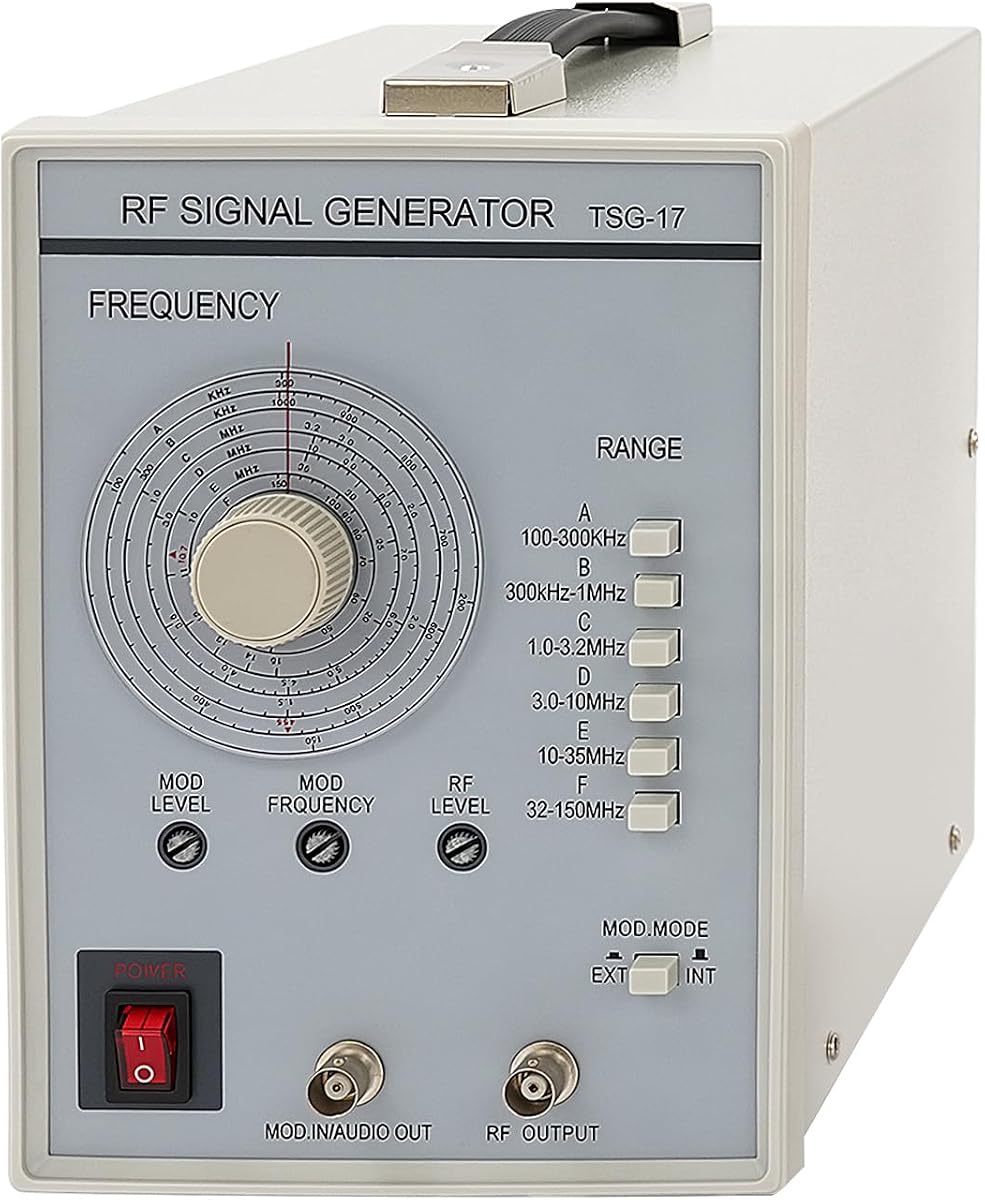
The TSG-17 provides a straightforward solution for generating RF and AM signals in a commercial or household setting. It operates on 110V standard power which ensures stable long-term operation.
We may earn a commission when you buy through this link, at no additional cost to you.
External modulation support allows users to introduce outside signals for testing purposes. The output range covers 100kHz to 150MHz which suits many standard radio frequencies.
However, user feedback indicates mixed experiences regarding its accuracy and stability. It may not be suitable for precision work where consistent signal purity is critical.
For basic alignment tasks or hobbyist projects where cost is the main concern, this unit serves a purpose. Verify its current condition and specifications before relying on it for critical tests.
Allows for external signal input between 50Hz to 20 KHz for advanced testing scenarios.
Running on 110V mains power eliminates battery dependency for stationary lab use.
We may earn a commission when you buy through this link, at no additional cost to you.
This device focuses on industrial standards with 4-20mA current and 0-12V voltage output. It is designed specifically for calibrating sensors and PLC systems rather than RF signals.
We may earn a commission when you buy through this link, at no additional cost to you.
A built-in lithium battery provides hours of operation without a power source. It also includes a PWM output for frequency and duty cycle adjustments up to 150 kHz.
Safety features include short circuit protection and reverse connection protection. The output values are stored even when power is off to save user configurations.
If your work involves industrial automation or process control, this generator offers the necessary precision. It is less relevant for RF testing but highly effective for electrical signal simulation.
Supports standard 4-20mA loops found in most factory control systems.
Short circuit and reverse connection protection prevent damage to the device and connected loads.
We may earn a commission when you buy through this link, at no additional cost to you.
The Riiai 0-10V 0/4-20mA offers high precision calibration with a clear 4-digit display. It covers both voltage and current ranges with a precision of 0.01V and 0.01mA respectively.
We may earn a commission when you buy through this link, at no additional cost to you.
Users can switch display modes easily and set up to nine fast signal output points for common values. It can be powered via micro USB or external DC supply depending on the setup.
Safety is ensured with short circuit and reverse connection protection. The compact size makes it easy to carry for field technicians working on panel debugging.
For electrical troubleshooting and control loop calibration, this unit provides excellent clarity and speed. It is a top choice for electrical engineers focusing on analog signal testing.
Calibrated accuracy ensures your signals are precise enough for sensitive instrument testing.
Options include battery, micro USB, or external DC power for maximum versatility.
We may earn a commission when you buy through this link, at no additional cost to you.
This SG003A model upgrades the simulation capabilities with a 2.4-inch TFT color screen and multiple signal types. It supports mA, V, and Hz pulse signals with a high precision of 0.01 units.
We may earn a commission when you buy through this link, at no additional cost to you.
The built-in 3000mAh battery provides up to 26 hours of use which is exceptional for field work. Real-time curve displays help visualize signal changes immediately without external tools.
Programmable auto modes allow the output to rise, fall, or cycle based on set parameters. This automation saves time during extensive testing sequences or training demonstrations.
For complex PLC testing and industrial diagnostics, this device offers the necessary depth. Its interface simplifies the process of generating dynamic signals for automated system checks.
Up to 26 hours of runtime ensures you can complete full shifts without recharging.
Real-time curve visualization helps identify signal drifts or anomalies quickly.
We may earn a commission when you buy through this link, at no additional cost to you.
The DROK generator simplifies analog signal creation with a single module design. It generates both ampere and voltage signals using a multi-cycle precise potentiometer for adjustments.
We may earn a commission when you buy through this link, at no additional cost to you.
Its interface is minimal, relying on rotary knobs rather than complex menus. This makes it extremely easy to use for quick checks without needing to navigate digital settings.
While it lacks digital precision features, it is reliable for basic PLC panel and LED testing. The compact design fits easily into tight spaces where larger units cannot go.
For technicians who value simplicity and speed over advanced features, this is a practical tool. It remains a common choice for routine analog calibration tasks.
A single multi-cycle potentiometer allows for fine-tuned control of output signals.
Minimal buttons and digital interfaces reduce the chance of user error.
We may earn a commission when you buy through this link, at no additional cost to you.
The SEESII Dual Channel 30MHz offers professional-grade precision with fully independent equal-performance channels. It supports a frequency range from 0.01uHz to 30MHz with high accuracy.
We may earn a commission when you buy through this link, at no additional cost to you.
Its 7-in-1 design integrates function, arbitrary, pulse, noise, frequency meter, counter, and sweeper into one device. This consolidation saves desktop space while providing extensive testing capabilities.
The 2.4-inch TFT LCD displays waveforms clearly allowing for easy parameter configuration. Complete accessories include alligator clips and test cables so you can start using it immediately.
For R&D engineers and lab managers requiring top-tier performance, this premium generator delivers exceptional results. It is built for reliability and consistency in demanding electronic design environments.
Fully independent channels allow for phase difference adjustment from 0 to 359 degrees.
With seven instruments in one, you can conduct a wide array of tests with a single purchase.
We may earn a commission when you buy through this link, at no additional cost to you.
Selecting the right generator depends on your specific testing requirements and budget. This guide outlines the critical factors to consider before making a purchase decision.
The frequency range determines the signals your device can produce. For RF work, look for units that cover at least up to 150MHz or higher. If you need to test basic circuits, lower ranges might suffice.
Always verify the maximum frequency spec against your application needs to ensure compatibility.
AM and FM modulation are essential for radio testing. Advanced units may offer PM and FSK as well which provides greater flexibility for complex signal analysis. Check if the device supports external modulation inputs for more control.
Choose a model that supports the specific modulation types required by your projects.
Single channel units are cost-effective for simple tasks. Dual channel generators allow for phase testing and simultaneous outputs which is vital for differential circuit verification. Evaluate if independent control is necessary.
Dual channels offer more versatility but may increase the cost and complexity of the device.
Basic generators produce sine, square, and triangle waves. Arbitrary waveform support allows for custom signal creation which is useful for specialized testing. Look for memory depth if you need to store custom patterns.
Ensure the device can generate the specific waveforms required for your test scenarios.
High resolution like 14-bit ensures precise signal output with low distortion. Frequency accuracy affects how closely your output matches the target value. These specs are critical for calibrating sensitive equipment.
Higher resolution and accuracy reduce errors in your measurement and testing results.
If you need to take the generator to the field, consider the size and battery life. USB powered units offer convenience but may have limitations on output power. Desktop units provide stability but are less portable.
Balance the need for mobility against the need for robust performance when choosing.
Modern generators often include USB ports for PC control and data logging. This allows integration into automated testing environments. Check if there is support for remote control via software.
Connectivity features can significantly enhance workflow efficiency in a lab setting.
A sturdy metal case protects internal components from damage. Look for units with protective features like short circuit protection and reverse polarity safety. These ensure long-term reliability in busy workshops.
Invest in a device with robust construction to withstand daily use and transport.
Always connect your generator to the correct impedance load to prevent damage. Start with low output levels and increase gradually to avoid sudden surges that could harm your device under test.
Keep the firmware updated if supported to access the latest features and bug fixes. Regularly calibrate the output using a standard reference to maintain accuracy over time.
Store the unit in a dry and cool environment when not in use. Avoid exposing it to extreme temperatures or moisture which can degrade internal components and reduce its lifespan.
An Amfm Signal Generator creates electronic signals with specific frequencies and modulation. It is used to test and calibrate radio receivers, amplifiers, and other RF equipment. Engineers rely on these devices to verify circuit performance accurately.
Choose a single channel model if you only need to test one signal path. Dual channel models are better for differential testing or when you need to compare two signals simultaneously. Consider your specific workflow before deciding.
For basic testing of standard circuits, standard waveforms like sine or square are sufficient. Arbitrary waveform support is necessary if you need to simulate complex or custom signals. Assess your testing needs before investing in advanced features.
Yes, most modern signal generators have standalone controls and displays. You can set frequency and modulation directly on the device. Computer control is an extra feature that adds convenience but is not strictly required.
Always ensure proper grounding to prevent electric shock. Do not exceed the maximum voltage or current ratings of the device. Use appropriate cables and connectors to avoid accidental short circuits during operation.
Calibration intervals depend on usage frequency and environment. Generally, annual calibration is recommended for professional use. If you notice output inconsistencies, perform a check immediately regardless of the schedule.
We reviewed ten top Amfm Signal Generator models ranging from budget-friendly options to premium instruments. The UNI-T UTG962E leads our list for its balance of performance and portability.
Prioritize the features that matter most for your work whether that is frequency range or modulation support. The right tool can significantly improve your testing efficiency and results.
Prices and availability are subject to change so please check current listings before buying. We hope this guide helps you find the perfect signal generator for your needs.