
Arduino UNO R4 WiFi
4.7Editor score
Dual Core Processing Power
Integrated LED Matrix Display
Bluetooth and Wi-Fi Support
Discover the top Arduino WiFi Module options for IoT projects. We compare features connectivity, and compatibility to help you choose the perfect wireless
Arduino WiFi Modules enable seamless wireless connectivity for your embedded projects. Whether you are building smart home devices or industrial sensors, selecting the right module ensures reliable communication and efficient data transfer across networks.
We evaluated ten top rated products based on performance, ease of use, and community support. Our comparison covers everything from beginner friendly transceivers to advanced boards with integrated processing power to find the best fit for your needs.
Each pick highlights unique strengths like dual core processing or low power modes. Remember that availability and shipping times change frequently so always check current stock before starting your next ambitious IoT development journey with these tools.
4.7Editor score

4.5Editor score

4.4Editor score
This side by side comparison breaks down the key specifications of all ten selected products. Use this table to quickly identify which module offers the specific features you need for your next wireless development project.



The Arduino UNO R4 WiFi stands out as a premium option for developers needing advanced capabilities. Its dual core design combines the Renesas RA4M1 with the ESP32-S3 to offer exceptional processing power for complex tasks.
We may earn a commission when you buy through this link, at no additional cost to you.
This board excels in wireless communication with stable Wi-Fi and Bluetooth 5.0 support. The integrated 12×8 LED matrix provides immediate visual feedback which is rare in standard microcontroller boards today.
While the price is higher than basic modules the added features justify the cost for serious projects. The CAN support and Qwiic connector make it suitable for industrial applications where reliability is paramount.
Choose this board if you need high speed communication and edge AI capabilities. It represents the future of Arduino development with features designed for modern embedded system challenges.
The combination of two distinct processors allows for dedicated handling of wireless tasks and main logic simultaneously improving overall system efficiency.
The built-in LED matrix removes the need for external displays in simple status applications saving space and simplifying circuit design.
We may earn a commission when you buy through this link, at no additional cost to you.
This pack offers three units of the classic ESP8266 ESP-01 module. It is an excellent choice for beginners who want to test wireless connectivity without investing too much money upfront.
We may earn a commission when you buy through this link, at no additional cost to you.
The ESP8266 chip provides robust processing capabilities for its size. It supports AP STA and combined modes allowing versatile networking configurations for different project requirements.
The small form factor can make soldering tricky for new users. However the low cost means you can practice wiring and debugging without worrying about damaging expensive components.
Ideal for prototyping where quantity matters more than individual feature depth. This module remains a staple in the maker community due to its proven reliability and wide support.
Buying in bulk reduces the per unit cost significantly allowing you to distribute modules across multiple projects or share with classmates.
Supporting multiple modes allows the module to function as a client server or both enabling complex mesh or relay setups.
We may earn a commission when you buy through this link, at no additional cost to you.
The ESP-01S variant improves on the original with more flash memory and a stronger signal. This makes it better for storing larger sketches and maintaining stable connections over longer distances.
We may earn a commission when you buy through this link, at no additional cost to you.
Four megabytes of flash allow for more complex firmware and library inclusion. This is a significant upgrade over older versions that struggled with memory constraints during development.
Programming requires selecting the correct board setting in your IDE. This minor hurdle is worth the performance boost you get from the enhanced hardware specifications.
Select this if you need a budget module that does not compromise on memory. It is perfect for projects requiring detailed logging or multiple sensor inputs stored locally.
The extra flash space enables you to include verbose debug logs or larger data structures without hitting storage limits.
The latest version includes tweaks to the antenna and RF circuit for better reception in noisy environments.
We may earn a commission when you buy through this link, at no additional cost to you.
This five pack provides ample stock for building a small network of sensors. The standard ESP-01 design ensures compatibility with a vast array of existing tutorials and shields.
We may earn a commission when you buy through this link, at no additional cost to you.
It supports common applications like smart grids and industrial control systems. The 1MB flash is sufficient for most telemetry and control scripts needed in these environments.
You must ensure your power supply stays within the 3.3V range. Exceeding this limit can damage the module so voltage regulation is critical for stability.
Great for classroom sets or team projects where multiple units are needed. The low price per unit makes it an ideal choice for mass deployment of simple sensors.
Having five units allows you to create a small mesh network or test different nodes in a distributed system simultaneously.
The robust design supports use in transportation and control fields where consistent connectivity is required over time.
We may earn a commission when you buy through this link, at no additional cost to you.
The ESP32 platform brings dual core performance to a developer friendly package. This board runs at speeds up to 240 MHz making it suitable for heavy tasks like machine learning.
We may earn a commission when you buy through this link, at no additional cost to you.
USB-C programming is a welcome modern upgrade. It simplifies connections and allows for faster data transfer compared to older micro USB standards found on many boards.
Over-the-air updates mean you do not need to unplug devices for every change. This feature is vital for deployed systems where physical access is limited or difficult.
Choose this for projects requiring high throughput or complex logic. It offers a balance of performance and ease of use that fits well in modern IoT workflows.
The dual core architecture lets you separate logic tasks from communication tasks ensuring stable connection while processing data.
OTA support allows you to push fixes to deployed nodes remotely saving time on physical maintenance visits.
We may earn a commission when you buy through this link, at no additional cost to you.
This Nano ESP32 combines the power of the ESP32-S3 in a compact Nano form factor. It supports MicroPython which opens up development to a wider audience familiar with Python.
We may earn a commission when you buy through this link, at no additional cost to you.
HID support allows the board to act as a keyboard or mouse. This unique feature enables custom controllers and remote input devices without extra hardware.
You will need to solder headers yourself since they are not included. This adds a step to setup but reduces shipping costs and allows flexible mounting.
Perfect for wearables or compact devices needing robust compute. It bridges the gap between standard C development and accessible Python scripting for embedded systems.
MicroPython compatibility means you can prototype logic quickly without managing low level memory or compilation details.
The ability to emulate HID devices turns the module into a powerful tool for automation and input interface creation.
We may earn a commission when you buy through this link, at no additional cost to you.
This four pack focuses on usability and material quality. The modules are designed to be reused multiple times which is great for educational labs and iterative testing.
We may earn a commission when you buy through this link, at no additional cost to you.
The self-calibrated RF ensures consistent performance across different units. This consistency helps avoid debugging issues caused by hardware variance in sensor networks.
These modules are suitable for wearable electronics and location sensing. Their small size and low power draw make them a good fit for portable projects.
Buy this if you need reliable units for repeated testing cycles. The focus on material quality ensures the modules can withstand the rigors of classroom or lab use.
Designed for multiple reuses these modules hold up well against repeated soldering and desoldering operations.
Calibration ensures that every module in the pack performs similarly reducing variables in wireless range testing.
We may earn a commission when you buy through this link, at no additional cost to you.
This package includes five units of the ESP-01S with 4MB flash memory. The extra storage is a key benefit for projects that need to store data locally before sending it.
We may earn a commission when you buy through this link, at no additional cost to you.
Documentation is clear about the SPI DOUT mode requirement during programming. Following this advice ensures you avoid errors when uploading code to the module.
You must use 3.3V power sources strictly to avoid damage. This limitation is standard for this chip family but requires a stable voltage regulator in your circuit.
Select this for applications needing local data logging or larger scripts. The combination of storage and multi-pack value makes it a strong choice for IoT deployments.
4MB flash allows buffering large sensor readings or logs that cannot be sent to the cloud instantly.
Specific instructions on baud rates and modes help reduce common setup errors during the flashing process.
We may earn a commission when you buy through this link, at no additional cost to you.
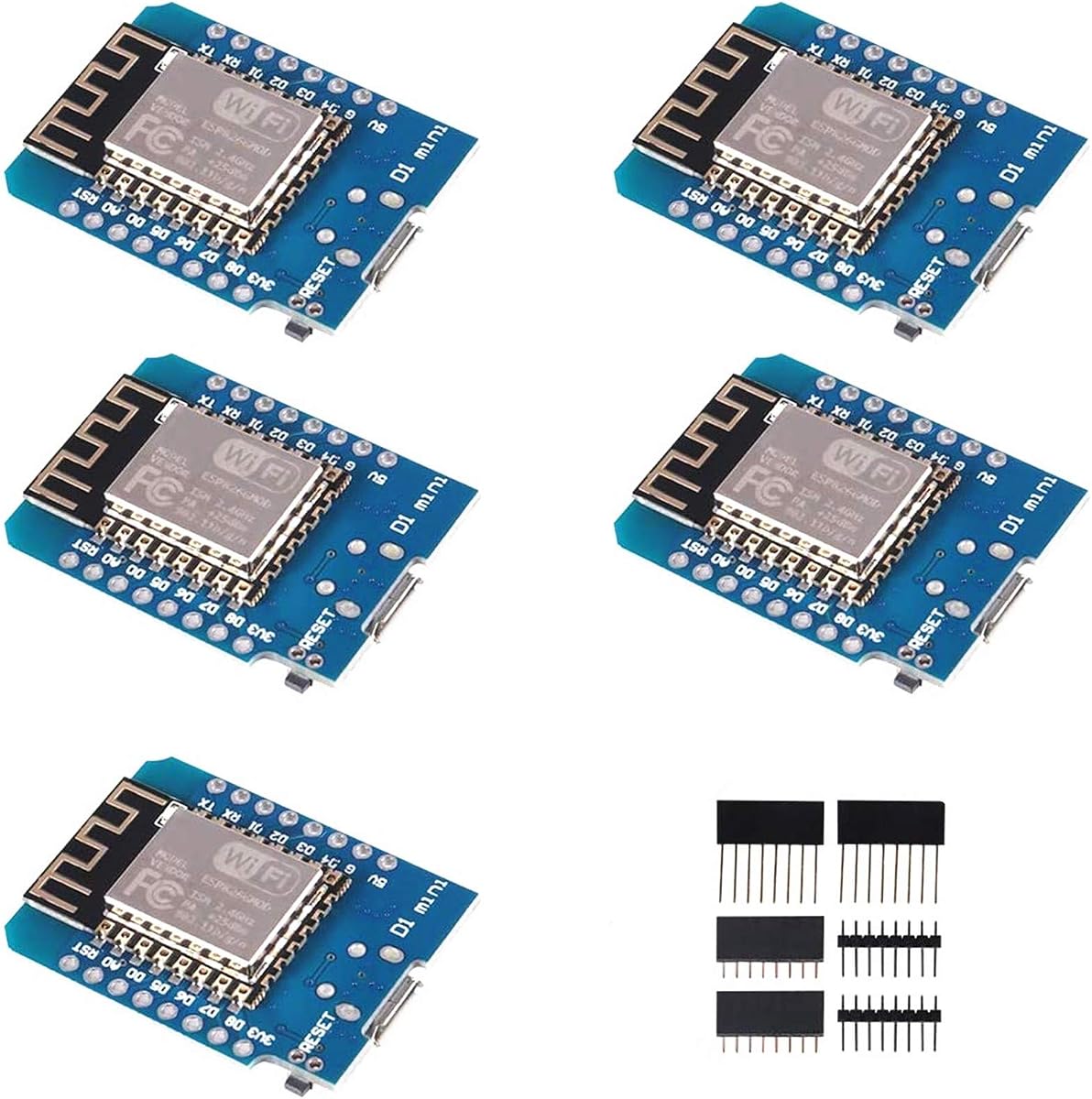
These D1 mini boards offer more pin access than the standard ESP-01. They come with an onboard USB connector which simplifies programming without extra adapters.
We may earn a commission when you buy through this link, at no additional cost to you.
The 11 digital pins allow for connecting multiple sensors simultaneously. This is useful for projects that require monitoring several inputs at once.
A 500mA fuse protects your circuit from short circuits. The onboard switching power supply handles voltage regulation efficiently to support varied inputs.
Ideal for intermediate builders needing pin flexibility. The built-in USB support reduces the need for separate USB to Serial converters in your setup.
More GPIO pins mean you can attach more components directly without needing multiplexers or extra breakout boards.
The resettable fuse ensures your board recovers from minor electrical faults without needing immediate replacement.
We may earn a commission when you buy through this link, at no additional cost to you.
This ten pack is the ultimate choice for bulk deployment or large class sets. It offers a perfect price to performance ratio for basic connectivity tasks.
We may earn a commission when you buy through this link, at no additional cost to you.
LWIP support in AP+STA mode simplifies network handling for developers. This streamlines the software side of getting connected to a local network or the cloud.
The on-board processing is robust enough for most standard logic tasks. It handles protocols well so you can focus on application logic rather than low level networking.
Perfect for large scale sensor networks or inventory projects. Having ten units means you can easily replace any faulty units without buying a new pack immediately.
A large pack allows you to scale your project quickly without worrying about running out of connectivity modules.
LWIP stack integration reduces the complexity of writing custom network code for your projects.
We may earn a commission when you buy through this link, at no additional cost to you.
Selecting the right module involves balancing power features and ease of use. We break down the most critical factors to help you make an informed decision.
Different modules offer different transmission strengths which affects how far you can place sensors from the router. Higher power modules generally require more battery or stable external power to operate continuously.
Check the output power rating to ensure it meets the distance requirements of your environment.
Flash memory determines how much code and data you can store on the board itself. Larger memories allow for more complex features and local data logging before transmission.
If you plan to log data locally prioritize modules with at least 4MB of flash space.
Most WiFi modules run on 3.3V which means you need a stable voltage regulator if your power source is 5V. Using 5V directly can damage the chip and void warranties immediately.
Always verify your board supports the voltage supplied by your power source before connecting.
Processing speed dictates how fast your device can handle calculations while maintaining a network connection. Dual core processors separate networking from main logic improving stability.
Choose higher speed options for applications that process data before sending it to the cloud.
Boards with built-in USB-C are easier to program than those requiring external adapters. This feature reduces clutter on your breadboard and simplifies power delivery.
Look for boards with integrated USB for a cleaner and more portable development setup.
Some modules support specific protocols like CAN or HID for industrial use. Ensure your module can handle the communication type required by your system or sensors.
Confirm support for protocols needed for your specific industrial or custom input application.
Make sure the board works with your preferred IDE and libraries. Some modules require specific board managers or libraries to function correctly in the Arduino environment.
Check online resources to ensure community support exists for your chosen module.
Battery powered projects need low power modes to last long periods. Look for features like deep sleep that allow the module to rest when not active.
Prioritize low power features if your device will run on a battery for months.
Start by connecting your module to a stable power source using a regulator if necessary. Ensure all ground connections are secure to avoid intermittent signal drops.
Install the correct board manager in your IDE before attempting to upload sketches. This step is crucial for successful communication between your computer and the module.
Avoid touching the antenna or exposed pins during operation to prevent static damage. Store unused modules in anti-static bags to maintain their integrity over time.
Many modern boards like the ESP32 have built-in USB interfaces so you do not need an external converter. However older modules like the ESP-01 require an adapter to connect to your computer for programming.
Drops often happen due to unstable power or interference. Ensure you use a stable power supply and check that no other devices are causing signal congestion on your chosen channel.
Some newer boards like the Arduino Nano ESP32 support MicroPython which allows you to code in Python. Older modules usually require C++ coding in the Arduino IDE.
Use Over-the-Air (OTA) update libraries to push changes via WiFi. This feature is available on most modern modules and saves the hassle of physical reprogramming.
AP mode lets your module act as a WiFi hotspot for other devices. STA mode makes it connect to an existing WiFi router to access the internet.
Some industrial variants support protocols like CAN which handle noisy environments better. Check the specs for robust communication features if your application is industrial.
Yes you can program multiple boards with the same code to create a network. Each board must have a unique identifier or IP to avoid conflicts.
We have reviewed ten top options ranging from budget friendly packs to premium dual core boards. The Arduino UNO R4 WiFi stands out for advanced users needing high performance.
For those looking for a balance of cost and features the ESP8266 variants remain popular choices for standard connectivity tasks. Consider your specific project needs before selecting.
Prices and availability can change so always check current listings before purchasing. We hope this guide helps you find the perfect module for your next project.