
ASRock Intel Arc Pro B60 Creator 24GB
3.9Editor score
24GB GDDR6 Memory
Xe2-HPG Architecture
PCIe 5.0 Support
Explore the top GPUs for running large language models locally. We compare memory, architecture, and performance to help you find the best GPU for Llm.
Choosing the right graphics processor is essential for running large language models efficiently. You need enough memory to load models and fast cores to generate text quickly. Without the hardware, local inference becomes slow and frustrating.
We evaluated ten top graphics cards based on memory capacity, architecture, and cooling. Our analysis covers consumer and professional options suitable for AI workloads. Each pick highlights key strengths and trade-offs for different user needs.
Every selection includes detailed specs and real-world performance notes. These picks show what each card offers for your setup. Prices change frequently so check current listings before you buy.
3.9Editor score

4.4Editor score

4.3Editor score
This side-by-side table compares memory capacity, architecture, and key features across all ten selected graphics cards to help you decide quickly.




The ASRock Radeon AI PRO R9700 Creator 32GB is a high-performance GPU designed for AI workloads. It holds a 4.4 rating and features massive memory ideal for large language models.
We may earn a commission when you buy through this link, at no additional cost to you.
Its 32GB of GDDR6 memory on a 256-bit bus ensures you can load bigger models without offloading. The RDNA 4 architecture includes dedicated AI accelerators to speed up inference and fine-tuning tasks.
Trade-offs include the cost and the need for professional driver support. These are acceptable since enterprise hardware delivers stability for heavy daily use in AI environments.
If you run LLMs locally for professional use, this card offers the right balance of memory and compute power. It is highly recommended for builders needing reliable local AI performance.
With 32GB of GDDR6 memory, you can load larger models and run complex inference tasks without slowdowns.
The blower cooler exhausts heat directly from the chassis, making it perfect for multi-GPU builds in tight cases.
We may earn a commission when you buy through this link, at no additional cost to you.
The ASRock Intel Arc Pro B60 Creator 24GB offers an exceptional value for running local AI. It holds a 3.9 rating and stands out with its huge memory at a low price.
We may earn a commission when you buy through this link, at no additional cost to you.
Its 24GB of GDDR6 memory allows you to run LLMs that would otherwise need more expensive cards. The Xe2-HPG architecture provides 197 INT8 TOPS for strong AI acceleration.
Trade-offs include a lower rating due to newer drivers. These are acceptable since you save money while still getting enough VRAM for serious models.
If you are on a budget but need capacity, this card is the smart choice. It delivers the essential ingredients for LLMs without breaking the bank.
You get 24GB of VRAM for less money than other cards, making large models accessible to more users.
The card supports Linux multi-GPU deployments so you can add more units later to boost total capacity.
We may earn a commission when you buy through this link, at no additional cost to you.
The NVD RTX PRO 6000 Blackwell Professional Workstation Edition is a flagship GPU for heavy AI needs. It holds a 4.3 rating and features a massive 96GB of error-correcting memory.
We may earn a commission when you buy through this link, at no additional cost to you.
Its 5th Gen Tensor cores support FP4 precision for faster AI model processing. The Universal MIG feature lets you divide the GPU into secure isolated instances for different users.
Trade-offs include the high cost and lack of retail packaging. These are acceptable for professionals who need maximum VRAM and enterprise reliability without cloud costs.
If you require top-tier performance for local LLMs, this is the ultimate solution. It removes memory limits entirely and delivers enterprise-grade speed.
With 96GB of DDR7 ECC memory, you can run the largest open-source models locally with zero VRAM bottlenecks.
The double-flow-through cooling design keeps the card cool under 600W loads to sustain peak performance.
We may earn a commission when you buy through this link, at no additional cost to you.
The GIGABYTE GeForce RTX 5080 Gaming OC 16G is a high-performance consumer card for AI work. It holds a 4.6 rating and features 16GB of the fastest new memory.
We may earn a commission when you buy through this link, at no additional cost to you.
Its Blackwell architecture and GDDR7 memory deliver great speed for inference. PCIe 5.0 ensures data transfer keeps up with the GPU cores for smooth operation.
Trade-offs include the 16GB memory limit for large models. This is acceptable if you use quantization or run smaller models that fit within this range.
If you want a powerful general-purpose card with strong AI features, this is a great pick. It offers excellent speed and build quality.
The GDDR7 memory provides higher bandwidth than older types to accelerate data transfer during inference.
The WINDFORCE cooling system keeps the card stable during long AI tasks to prevent thermal throttling.
We may earn a commission when you buy through this link, at no additional cost to you.
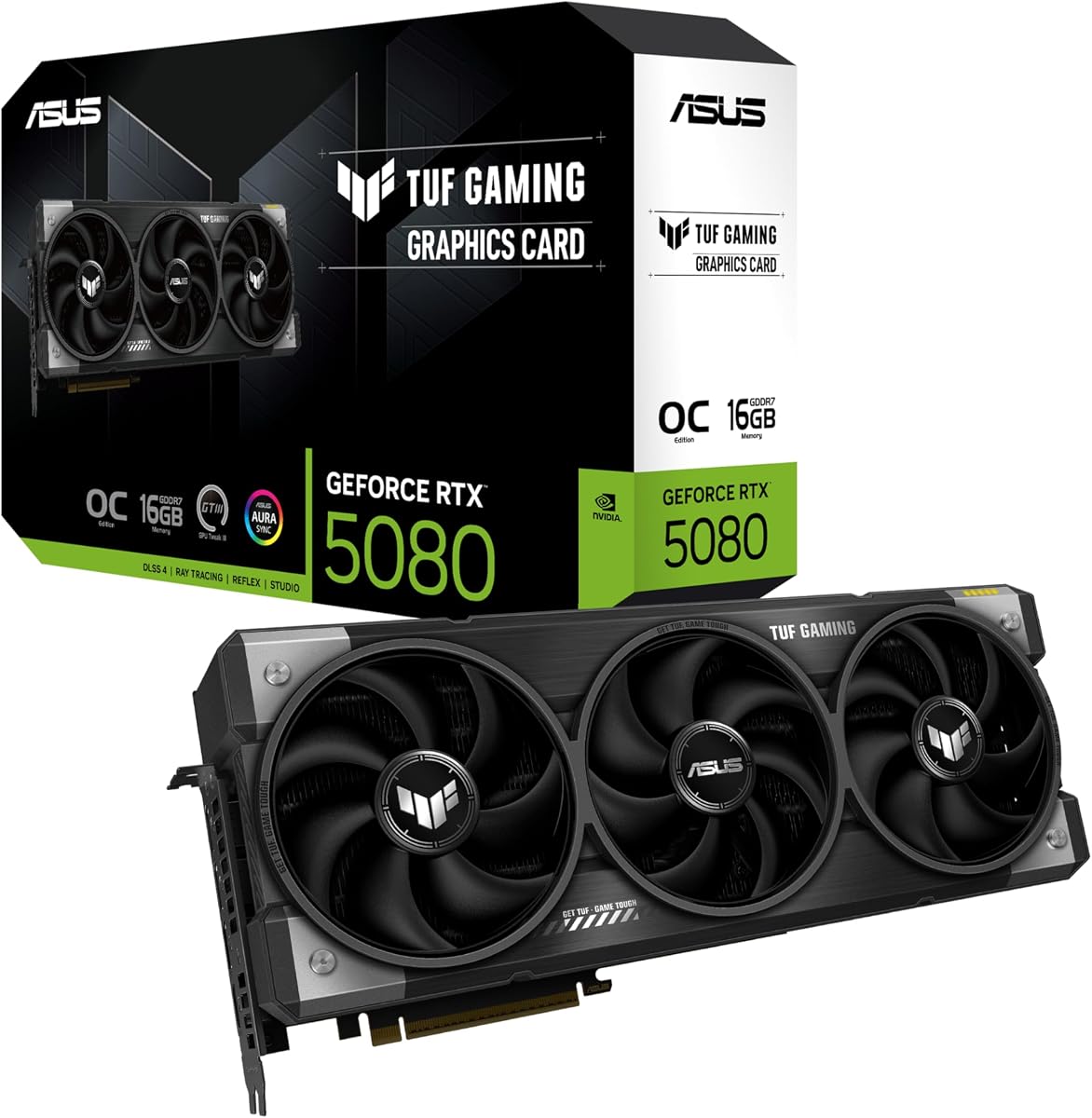
The ASUS TUF Gaming GeForce RTX 5080 16GB GDDR7 OC Edition is a rugged GPU for demanding workloads. It holds a 4.6 rating and features military-grade components for extra durability.
We may earn a commission when you buy through this link, at no additional cost to you.
Its phase-change thermal pad ensures long-lasting cooling performance under heavy loads. The protective PCB coating guards against moisture and dust in various environments.
Trade-offs include the power needs and size. These are acceptable because the durability ensures the card lasts through years of use.
If you prioritize build quality and reliability, this card is a strong choice. It offers excellent protection and thermal performance.
Phase-change thermal pads outlast traditional paste and keep the GPU running cool during extended sessions.
Military-grade components and protective coatings ensure the card survives tough conditions.
We may earn a commission when you buy through this link, at no additional cost to you.
The ASUS Turbo Radeon AI PRO R9700 32GB is tailored for local AI execution. It holds a 3.6 rating and offers 32GB of memory specifically for LLMs.
We may earn a commission when you buy through this link, at no additional cost to you.
Its 128 AI accelerators deliver up to 1,531 TOPS for fast inference. The 2-slot design and PCIe 5.0 support make it ideal for multi-GPU clusters.
Trade-offs include the need for active monitoring. These are acceptable since the hardware is designed to handle sustained training workloads.
If you need to scale local clusters, this card is a solid option. It offers the right memory and connectivity for scaling.
This card is built specifically for running LLMs locally without needing offloading to other systems.
Its dense 2-slot design lets you install multiple cards together to build a powerful local AI server.
We may earn a commission when you buy through this link, at no additional cost to you.
The ASUS Dual GeForce RTX 5060 Ti 16GB GDDR7 OC Edition is a compact choice for entry-level AI. It holds a 4.7 rating and offers 16GB of memory in a small chassis.
We may earn a commission when you buy through this link, at no additional cost to you.
It delivers 767 AI TOPS to handle moderate LLM tasks. The Dual BIOS lets you toggle between quiet and performance modes for different usage scenarios.
Trade-offs include less raw compute than flagship models. This is acceptable for users running smaller models in compact PC builds.
If you have space limits but need enough memory, this is the right pick. It balances size and capacity well.
The 2.5-slot size fits in smaller cases while still providing enough memory for standard LLM inference.
0dB technology stops fans at low loads for a silent experience when idle or doing light tasks.
We may earn a commission when you buy through this link, at no additional cost to you.
The Tesla L40S 48GB AI HPC Graphics Accelerator is a specialized card for data centers. It has no consumer rating but is built for high-performance computing and AI.
We may earn a commission when you buy through this link, at no additional cost to you.
Its 48GB VRAM supports large models in server environments. This accelerator is designed for workloads that require sustained operation and massive compute.
Trade-offs include the need for rack mounting and power. These are acceptable for IT admins who need server-grade hardware.
If you manage a server room for AI training, this card is the right tool. It delivers stability and capacity for enterprise tasks.
This accelerator is built for racks and data centers to run heavy workloads without interruption.
We may earn a commission when you buy through this link, at no additional cost to you.
The NVIDIA RTX PRO 6000 Blackwell max-Q Workstation Ed. 96GB GDDR7 ECC GPU is a powerful workstation part. It has no rating but features 96GB of ECC memory for precision.
We may earn a commission when you buy through this link, at no additional cost to you.
It delivers up to 3,511 TOPS of AI performance in a 300W envelope. This efficiency makes multi-GPU scaling viable for research labs and studios.
Trade-offs include the lack of consumer documentation. These are acceptable for professional users seeking local AI speed.
If you need a high-efficiency workstation GPU, this model delivers strong local AI. It removes VRAM limits while saving power.
The Max-Q design caps power at 300W for better thermal management in tight workstations.
We may earn a commission when you buy through this link, at no additional cost to you.
The ASUS Turbo Radeon AI PRO R9700 32GB is a turbo variant for AI workflows. It holds a 3.6 rating and features a 2940MHz Boost Clock for speed.
We may earn a commission when you buy through this link, at no additional cost to you.
Its phase-change thermal pads help keep clocks steady during long runs. Real-time monitoring via GPU Tweak III lets you track memory and temperature.
Trade-offs include thermal demands in dense clusters. These are acceptable for users who need the extra clock speed.
If you want top clocks on a budget-friendly workstation GPU, this card fits well. It is a strong pick for focused tasks.
A 2940MHz Boost Clock allows this card to push faster inference speeds than standard variants.
We may earn a commission when you buy through this link, at no additional cost to you.
Choosing the right GPU requires looking at memory, architecture, and thermal design.
VRAM capacity is the most critical factor for running large language models locally. If your model fits entirely in GPU memory, inference is much faster than offloading parts to system RAM. Look for at least 16GB to run standard models and 24GB or more for larger ones.
Prioritize cards with the highest VRAM you can afford to avoid performance bottlenecks.
Memory bandwidth determines how quickly the GPU can access its VRAM. Higher bandwidth speeds up token generation and reduces wait times during inference. Check specs like 512-bit bus widths to ensure rapid data transfer.
Select a card with high bandwidth to keep your models running at peak speed.
The GPU architecture impacts AI acceleration efficiency. Look for 5th Gen Tensor Cores or dedicated AI accelerators that optimize matrix math. Newer architectures provide better performance per watt for local inference.
Choose a model with recent architecture to ensure compatibility and speed.
Thermal design matters when running sustained inference or training tasks. A blower style cooler helps in multi-GPU setups to exhaust heat out of the case. Phase-change thermal pads ensure consistent performance over time.
Ensure your card has a cooling solution that handles long periods of load.
PCIe 5.0 support ensures your GPU can communicate with the CPU quickly. This is vital for loading models into memory efficiently. Also consider multi-GPU scaling if you plan to add more cards later.
Pick a card with PCIe 5.0 to future proof your local AI workstation.
High-performance GPUs often need strong power supplies and enough case clearance. Verify the PSU wattage and connector types before purchasing. Cards with high TDP require more electricity and generate more heat.
Check your PSU capacity to ensure stable operation under load.
Professional GPUs often come with specialized drivers for AI workloads. Consumer cards may need extra steps to enable certain features. Ensure the card supports your preferred framework and software stack.
Confirm driver compatibility before buying to avoid setup headaches.
Balance cost against the needs of your specific tasks. Sometimes a cheaper card with more VRAM offers better value than an expensive one with less. Consider your total system cost when selecting.
Look for the best capacity per dollar to maximize your investment.
Install the latest drivers from the manufacturer to ensure compatibility with AI frameworks. Use CUDA or ROCm as required by your inference engine to unlock full performance.
Monitor temperatures using tools like GPU Tweak III or other utilities. Clean dust from fans regularly to maintain thermal efficiency and prevent throttling during long tasks.
Keep your operating system and GPU firmware updated. Regular updates fix bugs and improve performance for the latest local language models.
For standard models you should aim for at least 16GB of VRAM. Larger models will run much better on 24GB to 32GB cards. Professional cards with 48GB or more allow you to run massive models without offloading.
Yes newer architectures with dedicated AI cores provide faster processing. Look for Blackwell or RDNA 4 designs that include Tensor cores. These optimize the math needed for running language models locally.
Yes many cards support multi-GPU scaling for local clusters. You can combine memory and compute power by installing several compatible GPUs. Check driver support to ensure your software can use multiple cards.
It is recommended for the fastest data transfer between CPU and GPU. PCIe 5.0 ensures your models load into memory quickly without delays. If budget allows choose cards with this interface for better efficiency.
A strong cooling solution is essential for 24/7 operation. Blower style coolers are great for tight cases with multiple cards. Look for cards with phase-change thermal pads for long term stability.
Consumer cards can run LLMs but may lack some stability features. Professional cards include enterprise drivers and ECC memory for reliability. For serious workloads choose workstation options to avoid downtime.
Check the card specs for required wattage and connectors. High performance cards often need 850W or more with specific 12V connectors. Ensure your PSU is reliable and has enough capacity.
Verify memory size and architecture against the model requirements. Most local inference tools list supported GPUs and VRAM needs. Always check the software documentation before purchasing hardware.
We compared ten top GPUs for running large language models locally and highlighted three standout picks. The ASRock Radeon AI PRO R9700 Creator 32GB offers the best balance of performance and memory for most users.
If you need budget capacity look to the ASRock Intel Arc Pro B60 Creator 24GB. For top tier performance and maximum VRAM the NVD RTX PRO 6000 Blackwell Professional Workstation Edition delivers unmatched power.
Remember to verify power and cooling requirements before you buy. Prices change so check the latest listings to ensure you get the best value for your build.