
DIGITEN G3/8" Water Flow Sensor
4.5Editor score
Low cost entry
Compact size
Simple wiring
Flow meters are essential tools for any maker working with water systems or liquid dispensing projects. These devices provide critical data that helps automate processes and ensure efficiency in various applications.
We evaluated ten leading models based on their compatibility with Arduino boards, sensor accuracy, build quality, and ease of installation. Our analysis focuses on real-world usability and reliability for DIY enthusiasts.
Each pick highlights specific strengths such as thread size, flow range, or cable length. Please note that availability and pricing may fluctuate, so verify current details before purchasing.
4.5Editor score

5.0Editor score

4.7Editor score
As an Amazon Associate we earn from qualifying purchases.
This side-by-side comparison highlights the key specifications and features of each selected flow meter to help you find the perfect match for your specific project requirements.


The DIGITEN G1.5" model stands out as the top choice for demanding projects requiring high flow rates. With a perfect rating and robust construction, it delivers reliable performance for industrial or heavy-duty DIY use.
We may earn a commission when you buy through this link, at no additional cost to you.
Its hall effect sensor provides accurate pulse signals compatible with most microcontrollers. The material meets ROHS standards ensuring safety for potable water systems without leaching harmful substances into the flow.
While it requires larger piping connections the G1.5 BSPT thread is common in commercial applications. The higher price is justified by the extended pressure resistance and longer operational life compared to smaller units.
If you need a flow meter that can handle significant volumes while maintaining precision this is the definitive recommendation. It is ideal for large water heaters or complex filtration setups.
Supports 5 to 150 liters per minute making it suitable for high demand applications.
Constructed from ROHS compliant materials safe for drinking water applications without contamination risks.
We may earn a commission when you buy through this link, at no additional cost to you.
This NPT threaded sensor is engineered for seamless integration into standard plumbing systems. Its compact lightweight design makes it ideal for tight spaces while the sealed hall effect sensor protects internal electronics.
We may earn a commission when you buy through this link, at no additional cost to you.
The pulse output mechanism ensures precise measurement of fluid movement across various appliances. Installation is straightforward provided the flow direction matches the arrow on the housing to ensure signal output.
Some users may need to adjust their piping to fit NPT threads specifically. However the reliability and ease of setup make it a strong contender for those prioritizing durability and simplicity.
This unit is best for users who need a reliable sensor for reverse osmosis or coffee machines. The premium features justify the investment for long term project stability.
Designed with NPT 1/2 thread to fit standard plumbing fittings without needing adapters.
Keeps the sensor dry and safe by sealing it away from the water pipe environment.
We may earn a commission when you buy through this link, at no additional cost to you.
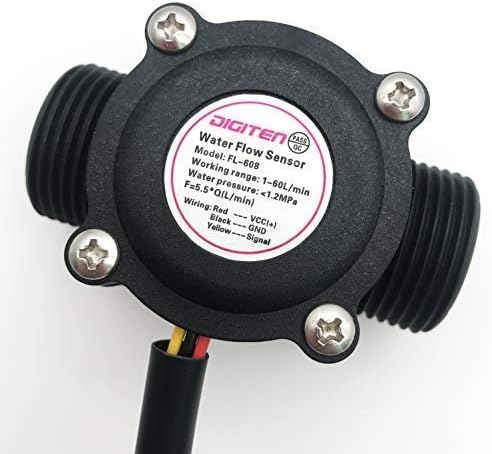
The DIGITEN G3/8" model offers exceptional value for those needing precise measurements on a budget. It delivers the core functionality required for Arduino projects without breaking the bank.
We may earn a commission when you buy through this link, at no additional cost to you.
Its small size makes it perfect for compact systems where space is limited. The wide voltage input range adds flexibility allowing use with different power sources or microcontroller boards.
While it cannot handle high volume flows it excels in drip irrigation or small dispenser projects. The waterproof design ensures longevity even in humid or wet environments.
This is the ideal pick for students or hobbyists starting their first liquid monitoring project. It provides a low risk entry point into flow measurement technology.
Provides essential measurement capabilities at the most affordable price in the entire selection.
Uses a G3/8 thread fitting for small pipe applications where larger sensors won't fit.
We may earn a commission when you buy through this link, at no additional cost to you.
This DEVMO unit is highly rated for its robust performance in water cooling and testing environments. It provides clear signal amplitudes that make it easy to interface with logic circuits or controllers.
We may earn a commission when you buy through this link, at no additional cost to you.
The 1/2 inch fitting matches standard plumbing needs allowing it to plug into various water systems. It is designed to switch effectively enabling automated control based on flow thresholds.
Users should ensure their power supply meets the specific high voltage amplitude requirements. Despite this minor constraint it remains a powerful tool for active cooling or monitoring systems.
It is recommended for builders looking for a reliable sensor that doubles as a switch. The high rating suggests consistent performance over time.
Functions as a control switch allowing automated systems to respond to flow changes.
Provides distinct high and low voltage signals for easier detection by Arduino boards.
We may earn a commission when you buy through this link, at no additional cost to you.
The food-grade designation makes this sensor a great choice for beverage dispensers or water purifiers. It ensures that the plastic materials do not contaminate the water flow passing through it.
We may earn a commission when you buy through this link, at no additional cost to you.
Its electrical specifications support a wide voltage range giving you flexibility in power source selection. The pressure rating is sufficient for most household applications where high pressure is not an issue.
While the rating is moderate it remains a reliable option for non-critical domestic use. Users should be mindful of the plastic construction if extreme temperatures are expected.
This is best for projects involving safe water handling where material compliance matters. It offers a balance of safety and functionality for home systems.
Uses food grade plastic to ensure water safety in dispensing and filtration applications.
Supports voltage from 5 to 24 volts allowing versatile power supply options.
We may earn a commission when you buy through this link, at no additional cost to you.
The transparent body of this sensor allows you to visually inspect the internal rotor and water flow. This feature is extremely useful for debugging projects to ensure the turbine is spinning freely.
We may earn a commission when you buy through this link, at no additional cost to you.
It comes in a two-pack which offers great value for testing multiple setups simultaneously. The wide voltage range ensures it works with various Arduino boards and power supplies easily.
Some users report lower durability compared to metal body sensors which limits long-term usage. However for prototyping and testing phases it provides unparalleled visual feedback for troubleshooting.
This is a great tool for educators or students demonstrating flow mechanics. The visual aspect helps in understanding how the sensor interacts with the fluid.
Transparent material allows direct viewing of the rotor to verify operation during debugging.
Comes in a two-pack allowing for redundancy or testing multiple projects at once.
We may earn a commission when you buy through this link, at no additional cost to you.
This tiny sensor is perfect for connecting directly to small garden hoses or tubing. Its low flow range makes it ideal for drip irrigation systems where every drop counts.
We may earn a commission when you buy through this link, at no additional cost to you.
The food-grade material ensures it can be used for drinking water dispensers safely. It supports low pressures which fits well with gravity fed systems or low pump setups.
The G1/4 connector is specific so ensure you have the right hose diameter. However for micro-scale projects this is one of the few available options that fits.
It is best for hobbyists working on small-scale hydroponics or water conservation systems. The compact size reduces drag and system complexity.
Uses a G1/4 inch connector specifically designed for standard hosepipe inner diameters.
Accurately measures low flows from 0.3 to 6 liters per minute for drip systems.
We may earn a commission when you buy through this link, at no additional cost to you.
The Taidacent unit uses the proven YF-S201 design which is standard in many maker projects. It offers a perfect rating suggesting that users find it reliable and easy to work with out of the box.
We may earn a commission when you buy through this link, at no additional cost to you.
Its interface supports G1/2 and G3/4 options making it adaptable to different plumbing standards. The hall effect sensor ensures a consistent pulse output that Arduino boards can count accurately.
There are no advanced features beyond standard flow measurement but the simplicity is a strength. It avoids unnecessary complexity while delivering the core measurement data required.
This is the go-to choice for those who want a standard solution that works reliably. It is excellent for water heaters or dispensers where standard sizing is critical.
Utilizes the classic YF-S201 architecture known for compatibility and ease of use.
Offers G1/2 and G3/4 interfaces to adapt to different pipe sizes easily.
We may earn a commission when you buy through this link, at no additional cost to you.
This DIGITEN model solves the wiring problem with a 1.2 meter cable pre-attached to the sensor. The SM2.54 connector allows you to plug directly into your board without soldering wires manually.
We may earn a commission when you buy through this link, at no additional cost to you.
The long cable provides flexibility in positioning the sensor away from your main electronics. This is crucial for projects where the water pipe is located far from the Arduino or Raspberry Pi.
The high rating reflects the convenience and ease of setup that users appreciate. The food grade material ensures it is safe for drinking water applications too.
Ideal for permanent installations where wiring neatly is a priority. It reduces setup time and improves the overall reliability of the electrical connection.
Features a 1.2 meter cable allowing flexible placement away from sensitive electronics.
Uses an SM2.54 connector for easy solder-free integration with control boards.
We may earn a commission when you buy through this link, at no additional cost to you.
This unit is designed for larger G3/4 pipe systems supporting higher flow rates up to 60 liters per minute. It includes a long cable which simplifies connections in large installations.
We may earn a commission when you buy through this link, at no additional cost to you.
The robust construction handles pressure up to 1.75 Mpa making it suitable for commercial grade water systems. However the lower rating suggests potential reliability concerns compared to smaller models.
Users should verify compatibility with their specific plumbing needs before purchasing. The large footprint may not fit in tight spaces compared to the 1/2 inch variants.
It is best for large scale commercial projects where flow volume is critical. If you need to manage larger pipes this offers the necessary capacity.
Accommodates G3/4 inch pipes for larger water flow systems in commercial settings.
Supports flow rates up to 60 liters per minute for high capacity systems.
We may earn a commission when you buy through this link, at no additional cost to you.
Selecting the right flow meter involves balancing technical requirements with physical constraints. Understanding these factors will help you avoid compatibility issues.
The flow rate range defines the minimum and maximum volume the sensor can measure accurately. Choosing a sensor where your expected flow sits in the middle ensures better precision.
Always select a model that covers your peak volume to avoid saturation.
Matching the thread size is critical for physical installation. Options include NPT, BSPT, and specific sizes like 1/2 inch or 3/8 inch.
Check your plumbing pipe diameter to ensure a leak free connection without adapters.
Arduino boards typically run on 5 volts so ensure the sensor works within this range. Some models support wider ranges like 3.5 to 24 volts for flexibility.
Verify the voltage input requirements match your power source to prevent damage.
For water dispensers or drinking water systems look for food grade materials. ROHS compliance ensures no harmful chemicals leach into the liquid.
This is essential for any project involving consumable water.
Most models output a pulse signal via a hall effect sensor. This allows your microcontroller to count rotations and calculate flow.
Ensure your code can read interrupt signals from the chosen pin.
Some sensors come with integrated cables while others have short leads. A longer cable simplifies wiring when the sensor is far from the controller.
Consider your installation distance to avoid the need for extra soldering.
Higher water pressure requires a robust housing to prevent leaks or breakage. Check the maximum pressure rating in Mpa for your system.
Standard models handle household pressure but commercial use needs higher ratings.
Established brands often offer better quality control and consistent performance. Check user reviews to verify longevity and accuracy.
Opting for a trusted name reduces the risk of faulty units.
Install the sensor in a horizontal or vertical pipe section ensuring the arrow on the body points in the direction of water flow. Tighten the connections with seal tape to prevent leaks.
Connect the output pin to an interrupt pin on your Arduino to capture pulses. Use a pull-up resistor if required by your specific model to ensure stable readings.
Flush the pipe before installation to remove debris that could jam the turbine. Regularly check for blockages or mineral buildup to maintain long term accuracy.
The YF-S201 is the most widely used model due to its simplicity and widespread support in library code. It is affordable and compatible with most standard water piping sizes.
Most flow sensors rely on the internal pull-up resistors of the microcontroller but some circuits benefit from external resistors. Check the datasheet to confirm the specific requirement for your model.
Yes if the sensor is labeled as food grade or potable water safe. Ensure the materials meet ROHS standards to avoid chemical contamination.
Multiply the number of pulses per second by the calibration factor specific to the sensor. This converts pulse frequency into liters per minute for accurate display.
Most sensors operate between 5 and 12 volts making them safe for Arduino 5 volt pins. Some models support wider ranges up to 24 volts for flexible power.
Attach the sensor to the pipe using a thread seal tape and ensure the flow direction arrow is followed. Secure the wiring to an interrupt pin to count signal pulses.
We have reviewed ten top models ranging from compact budget units to high capacity industrial sensors. Each brings unique strengths suited for different project scales.
Prioritize thread compatibility and voltage range to ensure seamless integration with your existing setup. The DIGITEN and DEVMO models offer excellent reliability for most hobbyists.
Check current prices and availability as market conditions change frequently. Selecting the right tool ensures accurate monitoring and long term success for your liquid systems.