As an Amazon Associate we earn from qualifying purchases. We may earn a commission when you buy through links on this page, at no additional cost to you. Read our affiliate disclosure.As an Amazon Associate we earn from qualifying purchases.Purchases through our links may earn us a commission, at no extra cost to you. Read our affiliate disclosure.
Batteries are essential for modern vehicles and equipment, yet they often suffer from sulfation over time. A quality battery restorer and desulfator can reverse this damage, restoring capacity and extending lifespan without the need for expensive replacements.
We analyzed ten top-rated products ranging from liquid additives to electronic pulse devices. Each option was evaluated on compatibility, safety, ease of use, and reported effectiveness across various lead-acid battery types including those in cars and golf carts.
Each pick below highlights unique features and ideal use cases to help you choose wisely. Remember that product availability and pricing can change frequently, so verify current details before making your final purchase decision today.
Top 3 Picks for Best Battery Restorer and and Desulfator
Best Budget
Battery Desulfator Reconditioner for 12V–72V Lead-Acid Batteries, Pulse Repair to Restore & Extend Battery Life – Works with AGM, Gel, VRLA, SLA, Flooded – for Car, RV, Solar, Marine, Golf Cart
Battery Restorer and Desulfator for Lead Acid – Prolong Life & Boost Charge Capacity, Battery Acid Refill and Additive for Golf Cart, RVs, Bikes, ATVs, Car 64oz
Top 10 Best Battery Restorer and and Desulfator in 2026 Compared
The following table provides a side-by-side comparison of all ten products to help you quickly identify the right solution for your specific battery maintenance needs and budget.
ProductsSpecificationsEditor scorePrice
1
Editor's Choice
Battery Restorer and Desulfator for Lead Acid – Prolong Life & Boost Charge Capacity, Battery Acid Refill and Additive for Golf Cart, RVs, Bikes, ATVs, Car 64oz
Battery Restore Desulfator Solution – 1 Gallon Refill – Treats 3 to 6 Lead Acid Batteries for Golf Carts, Motorcycles, Boats, ATVs, RVs & Forklifts – Extends Battery Life – Made in the USA – Non-Toxic
Battery Restorer and Desulfator for Lead Acid – Prolong Life & Boost Charge Capacity, Battery Acid Refill and Additive for Golf Cart, RVs, Bikes, ATVs, Car 64oz
64oz liquid formula
All lead acid types
Safe and reliable
Extends battery life
This product ranks as a top contender for its proven ability to revive weak lead acid batteries. With a 3.8 rating, it offers a reliable method to reduce sulfation buildup without replacing costly units.
Pros
High success rate
Budget-friendly option
Versatile applications
Improves charge capacity
Protects internal components
Cons
Results vary by condition
Requires regular charging
We may earn a commission when you buy through this link, at no additional cost to you.
Its formula works across various applications including golf carts and RVs. Users appreciate the safety profile that prevents internal damage while boosting chemical balance for extended performance.
While it may not fix completely dead cells, it is effective for batteries that still accept a charge. Regular use during charging cycles yields the best long-term results for maintaining capacity.
Buyers looking for an affordable liquid additive will find this solution appealing. It is an excellent starting point for those wanting to extend the life of their existing battery fleet.
Cost-effective Battery Maintenance
Save money by avoiding new replacements with this budget-friendly additive solution.
Wide Compatibility Range
Use it on everything from car batteries to tractors with ease.
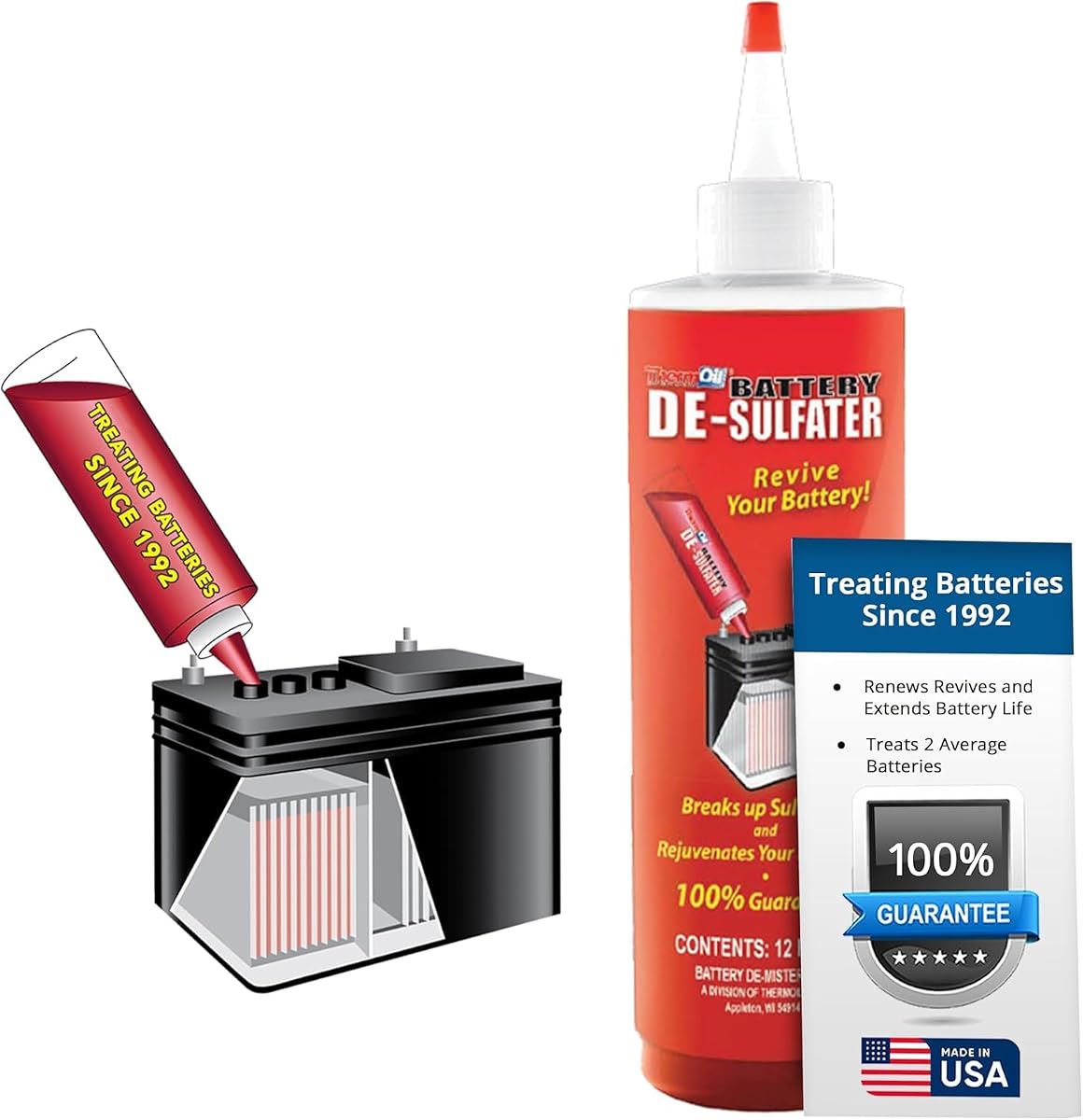
Thermoil's solution stands out for its unique formula free of Epsom salts. This distinction ensures a cleaner process for treating sulfated batteries without introducing unnecessary elements.
Pros
Zero Epsom salts
Enhanced performance
Safe for all batteries
Prevents overcharging damage
Hassle-free usage
Cons
Higher price point
Takes time to work
We may earn a commission when you buy through this link, at no additional cost to you.
The product promises enhanced performance by breaking down corrosion on battery plates. Users report reduced internal heating and elimination of resistance by up to fifty percent.
While the price is higher than some competitors, the guarantee offers peace of mind. It is a safe investment for those concerned about chemical hazards and battery integrity.
Ideal for fleet owners or enthusiasts who want a trusted brand. Follow the simple electrolyte additive instructions for best results over a few weeks.
Cleaner Chemistry
Avoid cheap fillers with a formula designed for pure battery care.
Performance Boost
Experience better power efficiency with reduced internal resistance.
Battery Desulfator Reconditioner for 12V–72V Lead-Acid Batteries, Pulse Repair to Restore & Extend Battery Life – Works with AGM, Gel, VRLA, SLA, Flooded – for Car, RV, Solar, Marine, Golf Cart
12V to 72V
AGM and Gel support
Built-in safety cutoffs
Pulse repair tech
This electronic desulfator offers advanced pulse technology at a competitive price point. It targets lead sulfate buildup physically rather than chemically for a different approach to repair.
Pros
High-frequency pulses
Wide voltage range
Built-in safety
Restores near-new condition
Rugged aluminum shell
Cons
Takes weeks to work
Requires charger pairing
We may earn a commission when you buy through this link, at no additional cost to you.
Supporting voltages up to 72V makes it versatile for deep cycle and solar systems. The aluminum shell ensures durability while smart cutoffs protect against low-voltage risks.
It requires pairing with a charging cycle to function effectively. Results typically appear after two to four weeks of consistent operation depending on battery age.
For hobbyists managing diverse battery types this device is ideal. It avoids chemicals entirely and suits those who prefer electronic maintenance tools.
Advanced Pulse Technology
Dissolve sulfate crystals with high-frequency electrical pulses.
A smaller version of the popular Thermoil solution this 12oz bottle offers portability. It delivers the same chemical benefits in a more manageable container for single vehicles.
Pros
Compact size
Non-acid formula
Increases power efficiency
Extends lifespan
Guaranteed satisfaction
Cons
Limited volume
May need multiple bottles
We may earn a commission when you buy through this link, at no additional cost to you.
The non-acid reconditioner enhances performance without harsh chemicals. It helps reduce internal heating and resistance while preventing damage from overcharging.
While practical for single batteries it may not suffice for fleets. Users should calculate their needs to ensure they have enough solution for their entire set.
Best for car owners wanting a targeted fix. The hassle-free additive process makes it simple to integrate into regular maintenance routines.
Portable Maintenance
Keep a bottle in your garage for quick and easy fixes.
Efficiency Gains
Enjoy increased power output with reduced internal resistance.
Battery Restore Desulfator Solution – 1 Gallon Refill – Treats 3 to 6 Lead Acid Batteries for Golf Carts, Motorcycles, Boats, ATVs, RVs & Forklifts – Extends Battery Life – Made in the USA – Non-Toxic
1 Gallon refill
Non-toxic formula
Made in USA
Treats 3 to 6
This large gallon format is designed for users managing multiple batteries at once. It treats three to six batteries making it cost-effective for golf carts and solar banks.
Pros
Large volume
Non-toxic safety
Made in USA
Fleet friendly
Easy application
Cons
Takes weeks to work
Not for dead batteries
We may earn a commission when you buy through this link, at no additional cost to you.
The non-toxic formula ensures safe handling in home garages. It chemically dissolves buildup to free plates for holding higher charges after ten days.
Users should note it does not revive dead or frozen cells. It is ideal for batteries that still accept a charge but struggle to hold it.
Fleet operators and collectors will appreciate the bulk size. Made in the USA it offers reliability and quality standards for critical equipment.
Cost per Bottle
The gallon size lowers the cost per individual battery treated.
Non-Toxic Safety
Handle the product safely without needing protective gear.
Battery Desulfator, Automatic Pulse Lead-Acid Battery Reconditioner for Life Extension and Repair (PL04C-400AH Blue)
Automatic operation
Deep cycle support
Easy installation
Pulse technology
A straightforward electronic desulfator this unit automates the reconditioning process. It connects easily to terminals to maintain lead-acid batteries in various settings.
Pros
Automatic operation
Versatile compatibility
Dissolves crystals
Simple connection
Maintains performance
Cons
Basic features
Takes weeks
We may earn a commission when you buy through this link, at no additional cost to you.
The pulse technology helps dissolve crystal buildup on plates. It is suitable for marine and RV batteries needing long-term maintenance and capacity recovery.
Setup is simple with no complex settings required for basic use. It works best as a continuous maintenance device paired with a charger.
Users seeking a set-and-forget option will find this useful. It offers an affordable way to keep batteries in good health over time.
Automated Care
Let the device run continuously to maintain battery health.
Wide Battery Types
Works with car marine and deep cycle lead-acid units.
Battery Renew Solution for Golf Cart Batteries – Lead Acid Restore, 1 Gallon
1 Gallon size
Best for maintenance
Made in USA
Works on lead acid
This solution targets fleets with a large volume bottle to treat multiple units. It breaks down lead sulfate buildup to restore charging capacity in flooded lead acid batteries.
Pros
Gallon size
Works on lead acid
Made in USA
Best for maintenance
Stop buying new batteries
Cons
Takes up to 10 days
Not for AGM or Gel
We may earn a commission when you buy through this link, at no additional cost to you.
Designed for professional use it supports maintenance routines for golf courses and marinas. Users can avoid frequent replacements by adding the correct dose to cells.
Note it does not work on AGM or Gel batteries. It is best for serviceable lead acid units that still accept a charge but have weakened over time.
Premium buyers looking for reliability will appreciate the US manufacturing. It is a robust choice for maintaining large battery banks effectively.
Maintenance Focused
Use it at the start of the season for best results.
Quality Standards
Produced in the USA to meet high quality benchmarks.
400AH Lead-Acid Battery Desulfator Battery Maintainer Auto-Setting for 12V-48V Auto Pulse Battery Revive Battery Regenerator
12V to 48V
400AH capacity
Auto-setting voltage
Can use with charger
This device handles higher capacity batteries up to 400AH. It uses auto-setting recognition to adjust voltage levels without manual intervention for ease.
Pros
High capacity support
Auto voltage setting
Easy connection
High-frequency pulse
Prevents sticking
Cons
Takes weeks to work
Requires voltage check
We may earn a commission when you buy through this link, at no additional cost to you.
It applies high-frequency peak pulses to remove lead sulfate gradually. This process keeps electrodes in a near-new state while extending overall battery life.
Users should check voltage before use to ensure it is above 11.5V. If too low the battery must be charged first before using the desulfator.
Suitable for heavy-duty applications needing maintenance. The auto feature simplifies setup making it accessible for non-technical users.
Auto Detection
The device recognizes battery voltage automatically for setup.
E-SDS Battery Restore Refill, Renew Liquid Solution for Lead Acid Batteries
Renew liquid solution
Breaks down sulfide
Easy to use
Versatile applications
This liquid refill helps enhance energy in batteries that struggle to charge. It breaks down sulfide layers and deposits to resume normal charging behavior.
Pros
Enhances energy
Breaks down sulfide
Easy to use
Versatile applications
Resumes charging
Cons
Requires recharge time
Not for damaged cells
We may earn a commission when you buy through this link, at no additional cost to you.
Users appreciate the easy use process requiring no draining of existing fluid. It maintains stable performance and extends the life of golf cart batteries.
It typically takes one to two hours of recharge to fully improve capacity. Do not use on batteries with physically damaged or completely dry cells.
Ideal for those wanting a quick liquid fix. Its versatility makes it suitable for boats and trucks alike.
Simple Application
Apply directly to cells without emptying the battery.
Energy Enhancement
Boost energy levels for stable performance in vehicles.
200AH Lead Acid Battery Desulfator 12-48V Auto Pulse Desulfator 2A Battery Regenerator Extending Battery Life
12V to 48V
200AH capacity
2A output
Auto pulse
A compact pulse regenerator this unit handles batteries up to 200AH. It uses auto pulse detection to maintain the state of lead-acid batteries automatically.
Pros
High pulse frequency
Auto pulse detection
Extends battery life
Easy to use
Supports AGM SLA
Cons
Takes weeks to work
Voltage check needed
We may earn a commission when you buy through this link, at no additional cost to you.
The high-frequency peak pulses decompose lead sulfate crystals gradually. This process extends life and improves performance after two to three weeks of use.
Users should connect correctly and verify voltage before use. It is designed to pair with chargers for optimal maintenance in various settings.
A solid choice for extending battery life affordably. It supports AGM SLA and VLRA batteries for wide compatibility.
Crystal Decomposition
Gradually removes sulfate buildup with high-frequency pulses.
Life Extension
Keep electrodes in near-new condition for longer use.
We may earn a commission when you buy through this link, at no additional cost to you.
Buying Guide – How to Choose the Best Battery Restorer and and Desulfator
Selecting the right tool depends on your battery type and the extent of damage. This guide covers key factors to consider before purchasing.
Battery Type Compatibility
Ensure the product matches your battery chemistry. Liquid additives usually work only on flooded lead acid cells and not AGM or Gel types. Electronic devices often support a wider range including SLA and VRLA.
Check the manufacturer specs to confirm your battery type is supported before buying.
Voltage Range
Verify the voltage range of your battery system. Devices must cover your specific voltage such as 12V or 48V. Incorrect matching may lead to ineffective treatment or safety risks.
Choose a device that explicitly supports your system voltage.
Chemical vs Electronic
Decide between liquid additives and pulse electronics. Additives dissolve crystals chemically and are easy to apply. Pulse devices use electricity to break down buildup but require setup.
Liquid is easier for beginners while electronic devices offer precise control.
Usage Volume
Consider how many batteries you need to treat. Bulk sizes like gallons offer value for fleets while small bottles suit single vehicles. Calculating volume needs prevents running out mid-process.
Buy larger volumes if you manage multiple batteries regularly.
Safety Features
Prioritize products with safety certifications. Look for non-toxic claims or built-in electrical protections like fuses and cutoffs. This minimizes risks during handling and operation.
Safety features protect both the user and the battery equipment.
Warranty and Guarantee
Look for products backed by guarantees or warranties. A promise of satisfaction ensures recourse if the product fails to deliver. This is crucial for expensive electronic units.
Check the guarantee terms before finalizing your purchase.
Ease of Use
Evaluate the steps required for application. Simple additive mixes save time while pulse devices may need terminal connections. Choose based on your technical comfort level.
Select the option that fits your maintenance schedule best.
Brand Reputation
Stick with established brands known for reliability. User reviews help gauge real-world performance beyond marketing claims. Trusted brands often offer better customer support and consistency.
Research the brand history and customer feedback before buying.
How to Use and Care for Your Battery Restorer and and Desulfator
First inspect the battery to ensure it is mechanically sound. Check for cracks or leaks as additives and devices cannot fix physical damage. Clean terminals and remove any corrosion before starting.
For liquids add the solution to cells after measuring carefully. Run a full charge cycle to allow the formula to dissolve sulfate crystals. Do not use if the battery is completely dry or frozen.
For electronic devices connect the red clamp to the positive terminal and black to negative. Ensure voltage is above minimum thresholds before activating. Monitor progress over weeks for optimal results.
Frequently Asked Questions
Can these devices revive a dead battery?
No these tools are designed for batteries that still accept a charge but struggle to hold it. Completely dead or dry cells cannot be revived by these methods. Check battery health before using any restorer.
Do additives work on Gel batteries?
Most liquid additives do not work on Gel or AGM batteries because they are sealed. Always check the product label for compatibility with sealed types to avoid damage.
How long does treatment take?
Results typically appear after a few days for liquids and up to a few weeks for electronic units. The time depends on the level of sulfation and battery age.
Is it safe to mix additives?
Never mix different brands of additives as chemical reactions may occur. Use only the recommended amount per cell to prevent overflow or damage.
Do pulse devices damage batteries?
No safe devices use controlled pulses that break down sulfate without harming plates. However ensure you use a quality product with proper safety cutoffs.
How often should I maintain my battery?
Apply additives or pulse devices every six months or at season start. Regular maintenance helps prevent sulfation buildup and extends lifespan effectively.
Final Thoughts on Choosing the Best Battery Restorer and and Desulfator
We reviewed ten top solutions covering both liquid additives and electronic pulse devices. The top picks offer reliability and value for extending battery life across various applications.
Prioritize compatibility with your battery type and ensure safety features are present. Whether you choose a chemical fix or electronic tool proper usage is key to success.
Always verify current availability and details before purchasing. Prices and stock can change but these products remain reliable choices for maintenance.