
RIGOL DHO924S Oscilloscope with Built-in Signal Generator
4.5Editor score
250 MHz bandwidth for high speed
Built-in signal generator included
50 Mpts memory depth for records
Digital oscilloscopes are essential tools for engineers and hobbyists who need to visualize electrical signals. They allow users to measure voltage over time, making it easier to diagnose issues in circuits and devices.
We compared ten top models based on bandwidth, channel count, resolution, and features like waveform capture and decoding. Each option offers unique strengths for different testing scenarios and budgets.
This list shows what each pick delivers in real-world use. Prices can change often, so check current listings before buying to ensure you get the best value for your specific requirements.
4.5Editor score
4.3Editor score

4.1Editor score
As an Amazon Associate we earn from qualifying purchases.
This table provides a quick side-by-side view of all ten models to help you compare their main specifications at a glance before making a decision.


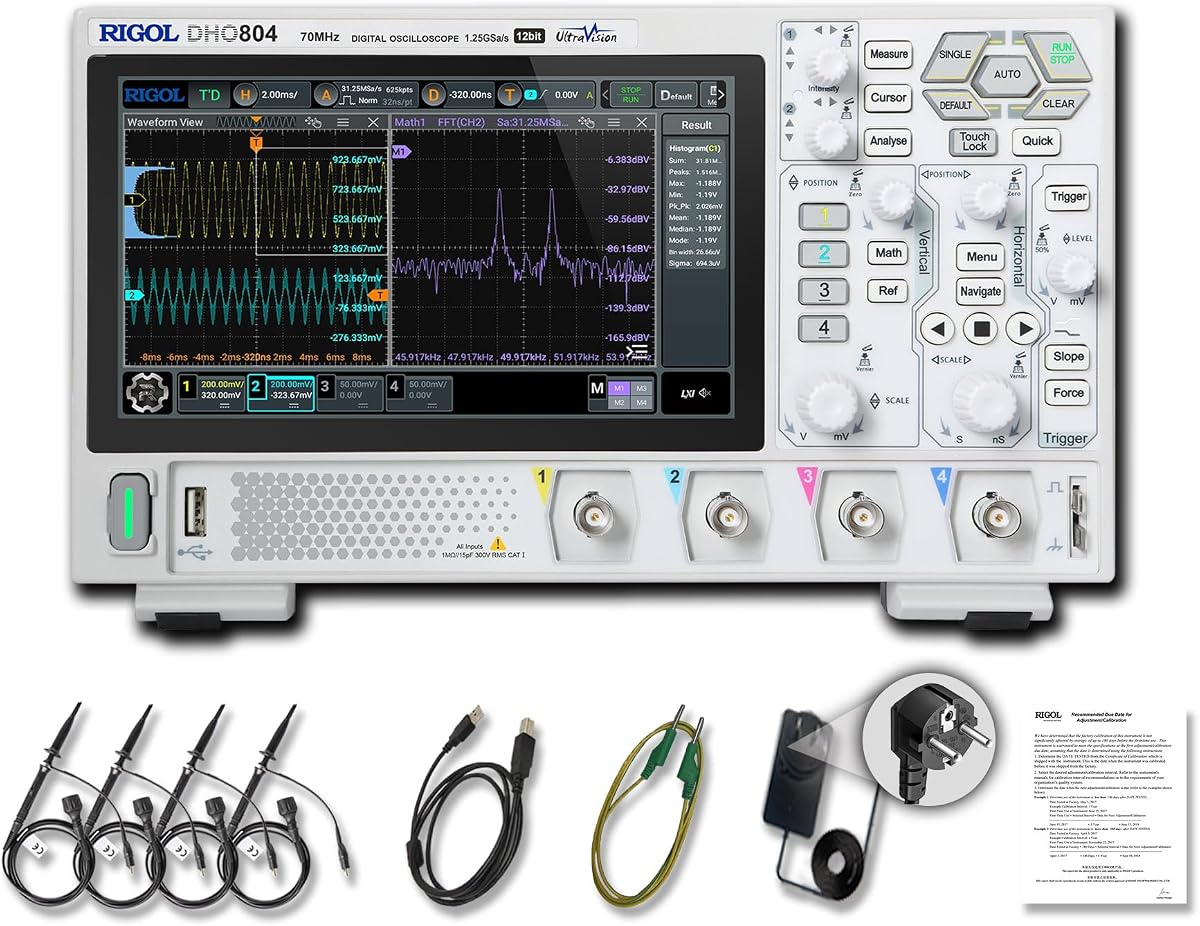
The RIGOL DHO804 stands out as a top choice for users needing detailed signal analysis without breaking the bank. It offers a solid 70 MHz bandwidth with four analog channels, which is rare at this price point. The 12-bit vertical resolution provides much finer detail than standard 8-bit scopes, making it ideal for power supply ripple and noise checks. Users praise its UltraAcquire technology for capturing glitches that might otherwise be missed.
We may earn a commission when you buy through this link, at no additional cost to you.
Its performance is backed by a fast waveform capture rate of up to one million wfms/s, combined with 256-level intensity grading. This helps users quickly spot intermittent issues in complex circuits. The scope includes powerful FFT and decode features for serial protocols like CAN, RS232, and I2C, which simplifies embedded system debugging. Connectivity is robust with LAN, USB, and HDMI, allowing easy remote control and documentation export.
While it excels in many areas, the 70 MHz bandwidth might limit users working with high-frequency RF signals. Additionally, the touchscreen, while convenient, can sometimes register unintended inputs during precise adjustments. These are minor trade-offs given the overall capability and price. For most engineers working on consumer electronics or embedded systems, this scope offers a balanced and powerful solution.
This model is best suited for professionals and serious hobbyists who need to analyze multiple signals simultaneously with high precision. The included Flex Knob and touch screen improve daily workflow efficiency. We recommend it for anyone prioritizing signal fidelity and channel count over raw bandwidth speed.
The 12-bit resolution allows you to see small voltage changes that standard scopes miss, which is critical for power integrity analysis.
Built-in serial decoding saves time by automatically interpreting signals from common communication buses without extra hardware.
We may earn a commission when you buy through this link, at no additional cost to you.
The RIGOL DHO924S is a premium option designed for users who need higher bandwidth and advanced features. With 250 MHz bandwidth and 12-bit resolution, it captures fast transients and long signal records effortlessly. The built-in arbitrary function generator makes it a complete bench solution for testing and validation without needing extra gear. Its S model variant adds Bode plot analysis for loop stability testing.
We may earn a commission when you buy through this link, at no additional cost to you.
Users benefit from 50 Mpts of memory depth, allowing extended captures at high sample rates. This is vital for analyzing complex embedded systems or long communication frames. The UltraAcquire mode with intensity grading helps visualize rare events, while remote control options like LAN and web interfaces facilitate automated workflows. It is an excellent choice for advanced engineering tasks.
The main drawback is the higher cost compared to entry-level models, which may not fit every budget. Also, the lack of a slow sweep or roll mode might be inconvenient for simple, continuous monitoring tasks. Despite these limits, the performance and included features justify the investment for those needing serious capabilities.
This oscilloscope is ideal for labs and professionals working on high-speed embedded timing and power supply validation. The combination of high bandwidth, resolution, and integrated testing tools makes it a versatile centerpiece for any modern electronics bench.
Having a signal generator built-in saves bench space and ensures perfect synchronization between your stimulus and measurement.
With 50 Mpts, you can zoom in on long timebases without losing sample resolution, preserving signal integrity.
We may earn a commission when you buy through this link, at no additional cost to you.
The FNIRSI DPOS350P offers an impressive array of features for a budget-friendly device. It combines a 350 MHz oscilloscope, spectrum analyzer, frequency response analyzer, and signal generator into a single handheld unit. This makes it incredibly versatile for field work or mobile labs where carrying multiple devices is impractical. The 7-inch touchscreen and large battery support extended independent use.
We may earn a commission when you buy through this link, at no additional cost to you.
Its 1 GSa/s sampling rate ensures accurate capture of fast digital edges despite its compact size. The spectrum analyzer function helps users check for electromagnetic interference and signal integrity issues without needing a separate instrument. Users appreciate the ability to store waveforms and screenshots directly on the device for later review. This is a powerful all-in-one tool.
The main limitation is having only two channels, which restricts simultaneous multi-signal analysis compared to four-channel models. Also, the build quality and long-term durability may not match professional benchtop units. These trade-offs are acceptable given the price and portability. It serves well for hobbyists and field technicians who need broad functionality.
This device is best for those needing a portable, multifunctional tool for EMI checks and general signal analysis. The inclusion of a spectrum analyzer and signal generator at this price point is rare and adds significant value. We recommend it for users prioritizing versatility and mobility over channel count.
With four distinct tools in one unit, you save money and reduce the weight of your test kit significantly.
The built-in battery and rugged design allow you to take the scope to the site without needing power outlets.
We may earn a commission when you buy through this link, at no additional cost to you.
The RIGOL DS1102Z-E is a classic model known for its high reliability and user-friendly features. It offers 100 MHz bandwidth and deep memory of up to 24 Mpts, allowing long captures without losing detail. The digital phosphor style display helps visualize jitter and noise effectively. With a rating of 4.9, it has satisfied thousands of users over time.
We may earn a commission when you buy through this link, at no additional cost to you.
Its serial bus decoding for RS232, I2C, and SPI makes it useful for embedded debugging without extra software. The waveform capture rate of 30,000 wfms/s helps reveal intermittent glitches that might be missed otherwise. Connectivity includes USB and LAN for easy data export and remote control. It is a solid choice for education and basic engineering work.
The two-channel limitation may require users to multiplex signals if they need more inputs simultaneously. Also, the design is older compared to newer touch-based models, though it remains functional and robust. These issues are minor for most general applications. It remains a top pick for those valuing stability.
This model is best for students and hobbyists entering electronics work. Its ease of use and proven track record make it a safe investment for learning and routine debugging tasks on a budget.
Users trust this model for consistent performance over many years of daily bench use without frequent failures.
Decoding serial protocols directly on the screen simplifies troubleshooting microcontroller communication issues significantly.
We may earn a commission when you buy through this link, at no additional cost to you.
The FNIRSI 2C53T combines an oscilloscope, multimeter, and signal generator into one compact unit. It offers 50 MHz bandwidth and a 4.5-digit multimeter for comprehensive electrical testing. The device supports waveform storage and export via USB-C, allowing easy backup of data. Its 2.8-inch screen and battery make it convenient for portable repairs.
We may earn a commission when you buy through this link, at no additional cost to you.
Users appreciate the integrated multimeter which reduces the need to carry separate tools. The signal generator can output standard waveforms up to 50 kHz, useful for testing audio or low frequency circuits. One-click save functionality simplifies documentation for repairs or maintenance logs. This makes it a strong contender for field technicians.
The 50 MHz bandwidth is low for digital or high-frequency work, limiting its use to basic analog or low-speed tasks. The display is also smaller than modern touchscreens, which can hinder complex analysis. These limits are acceptable for entry-level or portable needs. It is a practical tool for general maintenance.
This device is best for technicians who need to measure voltage and view waveforms on the go. The combination of meter and scope in one unit saves time and money for basic troubleshooting tasks.
Carrying one device that acts as a scope and multimeter simplifies your workflow and reduces what you carry.
Built-in high voltage protection helps prevent accidental damage when testing mains or high voltage circuits.
We may earn a commission when you buy through this link, at no additional cost to you.
The FNIRSI DSO152 is a pocket-sized oscilloscope ideal for basic troubleshooting. With 200 kHz bandwidth, it covers audio and low-frequency signal work perfectly. Its tiny size means you can carry it anywhere without extra bulk. The auto settings function displays waveforms immediately without manual tweaking.
We may earn a commission when you buy through this link, at no additional cost to you.
Users find it excellent for checking power supply ripple or audio signals in small electronics. The built-in battery supports four hours of use, which is enough for most field calls. Firmware updates allow adding new features over time, keeping the device relevant. It is a great starter tool for hobbyists.
Its main limitation is the narrow bandwidth, making it useless for digital logic above audio frequencies. The screen is also small, which makes detailed measurements harder. These drawbacks are expected at this price. It serves well for simple, low-speed tasks.
This model is best for beginners needing a basic visual check of signals. Its affordability and size make it a low-risk investment for those starting out in electronics repair.
You can fit this scope in a shirt pocket, keeping it always available for quick checks without setup.
One button press adjusts all parameters to show a clear waveform, removing the learning curve for new users.
We may earn a commission when you buy through this link, at no additional cost to you.
The Hantek DSO2D15 provides a solid entry into 150 MHz testing. It offers two channels with a variety of trigger modes and serial protocol support. The arbitrary waveform output allows for simple signal generation tasks directly from the scope. Users find it useful for educational and communication testing applications.
We may earn a commission when you buy through this link, at no additional cost to you.
Its price point makes it accessible for small labs or hobbyists who need higher bandwidth than entry-level models. The package includes necessary probes and supports various trigger conditions for stable displays. It is a practical tool for basic lab setups where budget is a priority.
The interface and build quality are more basic than premium brands, which can affect long-term usability. It lacks advanced features like touchscreens or deep memory. These compromises are typical at this price. It remains a viable option for focused tasks.
This oscilloscope is best for students and small workshops needing reliable mid-range bandwidth. It balances cost and functionality for general electronics debugging and learning purposes.
Its straightforward controls and decent bandwidth make it suitable for teaching students about signal behavior.
Multiple trigger modes ensure you can stabilize complex waveforms for easier viewing and measurement.
We may earn a commission when you buy through this link, at no additional cost to you.
The FNIRSI 1013D Plus features a large 7-inch touchscreen which improves usability. It offers 100 MHz bandwidth and a 1 GSA/s sampling rate for decent digital work. The 6000 mAh battery supports up to four hours of continuous use. Users appreciate the built-in voltage protection and waveform storage features.
We may earn a commission when you buy through this link, at no additional cost to you.
Its touch interface simplifies navigation and measurement tasks compared to rotary knobs. The waveform manager allows browsing stored screenshots and data easily. This is useful for documenting faults during maintenance. It is a strong portable option for field engineers.
The two-channel design limits simultaneous multi-signal monitoring. The touch response can sometimes lag on low-end hardware. These issues are manageable for most tasks. It remains a capable tool for general use.
This model is best for users wanting a touch-screen portable scope. It provides good value for mid-range bandwidth with modern interface features.
The 7-inch screen provides ample space to view waveforms and menus clearly in various lighting conditions.
With 6000 mAh capacity, you can work for hours without needing an external power source on-site.
We may earn a commission when you buy through this link, at no additional cost to you.
Data for this item is currently unavailable in our source. You may need to check the product page for specific details. The link is provided for your convenience. Please verify the model number before purchasing.
We may earn a commission when you buy through this link, at no additional cost to you.
We recommend looking at the manufacturer site for accurate technical specs. Sometimes listings update slowly on third-party platforms. Ensure the product meets your requirements before buying.
Missing details make it hard to compare this item directly. Check recent reviews for user feedback. This is a placeholder for an item with incomplete data.
We advise caution when buying products with limited public info. Verify seller reputation and return policies. This slot highlights the need to check listings carefully.
Always double-check specs and seller reputation when detailed product information is not publicly available.
We may earn a commission when you buy through this link, at no additional cost to you.
This item also lacks detailed data in our source. We cannot provide a full review without more technical information. Use the provided link to visit the product page. Confirm compatibility before ordering.
We may earn a commission when you buy through this link, at no additional cost to you.
We suggest contacting the seller for any missing specs. Listings may change over time. Ensure you have the right model for your needs.
Incomplete data prevents a fair comparison with other top picks. Check for updated info. This serves as a reference link for interested buyers.
Please review recent customer feedback if available. We advise comparing this item carefully with confirmed alternatives.
Confirm the exact model specs before purchase to ensure it matches your project requirements.
We may earn a commission when you buy through this link, at no additional cost to you.
Choosing the right scope depends on your specific testing needs and budget. This section outlines the key factors to consider.
Bandwidth determines the maximum frequency the scope can measure accurately. Choose at least five times the highest frequency of your signal. Higher bandwidth costs more but ensures cleaner traces.
For general electronics, 100 MHz is often enough. For RF work, consider models with higher MHz ratings.
Sample rate affects how much detail the scope captures per second. A higher sample rate prevents aliasing and ensures accurate waveform reconstruction. Look for real-time sample rates in MSa/s or GSa/s.
Ideally, sample rate should be at least four to ten times the bandwidth. Check specs to confirm it meets this ratio.
Memory depth controls how long you can capture signals without losing detail. Deep memory allows zooming in on large time spans. It is vital for capturing intermittent glitches or long communication frames.
For embedded systems, deeper memory helps analyze long bursts of data. For basic use, standard depth may suffice.
Most scopes come with two or four analog channels. Two channels are standard, but four allow simultaneous monitoring of multiple rails or protocols. Consider your typical test setups.
If you need to compare signals across different domains, four channels offer better flexibility without multiplexing.
Modern scopes include USB, LAN, and HDMI. Connectivity helps export data and automate tests remotely. Check if you need remote control or web interface features.
For lab integration, LAN and SCPI support are useful. USB is essential for saving screenshots and waveforms.
Touchscreens simplify operation but traditional knobs offer precision. Larger screens improve visibility in the field. Check resolution and viewing angles for your environment.
Touch interfaces speed up menus and measurement selection. Traditional buttons provide better tactile feedback for adjustments.
Handheld units with battery support are key for field work. Benchtop models usually need mains power. Consider weight and size for travel requirements.
If you work on-site, a portable unit with at least four hours of battery life is recommended.
Features like serial decoding and FFT can save significant time. Some models include built-in signal generators. Decide if these tools replace separate gear.
Integrated features reduce equipment clutter but add to cost. Ensure they match your specific debugging needs.
To start using your scope, connect the probes to the channels and ensure they are compensated. Adjust the vertical and horizontal scales until the waveform fits the screen. Use the auto-scale function if available.
Keep probes clean and check for damage before each use. Clean the screen with a soft cloth and avoid harsh chemicals. Store the unit in a dry place when not in use to prevent moisture damage.
Perform self-calibration periodically using the built-in calibration signals. Update firmware when available to get new features and security patches. Follow the manufacturer's maintenance schedule for optimal performance.
For most hobbyist and general electronics work, a 50 to 100 MHz bandwidth is sufficient. This covers most digital logic and audio frequencies. If you work with RF, look for higher bandwidth models.
Two channels are enough for basic signal analysis. Four channels are better for complex systems where you need to compare multiple signals or power rails simultaneously without switching.
Digital scopes store waveforms in memory allowing for analysis later. Analog scopes display signals directly on a CRT. Modern users almost always prefer digital for memory and math features.
You can measure low frequency RF signals with a standard scope if bandwidth is sufficient. For high RF work, dedicated RF spectrum analyzers are better suited for the task.
Use the scope's built-in calibration outputs to adjust probes. Most units have a calibration menu or specific steps. Follow the manual to ensure voltage accuracy before testing.
Touchscreens speed up navigation and measurements but can lack precision. Buttons offer tactile feedback. Many models now include both options for best of both worlds.
We reviewed ten digital oscilloscopes ranging from entry-level handhelds to premium benchtop models. The top picks offer excellent value for their respective categories and use cases.
Prioritize bandwidth and channel count based on your specific testing needs. Features like deep memory and connectivity can save time in complex environments.
Prices and availability change frequently. Verify the current details before purchasing to ensure you select the right tool for your projects.